$ traceroute6 www.amazon.com
traceroute6: `www-amazon-com.customer.fastly.net' has multiple addresses; using `2606:2cc0::374'
traceroute6 to www-amazon-com.customer.fastly.net (2606:2cc0::374) from 2600:1f18:400c:b800:bdf1:6584:1971:4efe, 64 hops max, 12 byte packets
 1  2620:107:4000:2210:8000:0:f405:667  58.911 ms  # 244.5.102.7
    2620:107:4000:2210:8000:0:3ec:3e71  0.831 ms
    2620:107:4000:2210:8000:0:3ec:3e73  0.808 ms
 2  2620:107:4000:a792::f000:3841  0.419 ms        # 240.0.56.65
    2620:107:4000:a792::f000:3843  0.473 ms
    2620:107:4000:a792::f000:3842  0.4 ms
 3  2620:107:4000:cfff::f20c:2b01  17.258 ms       # 242.12.43.1
    2620:107:4000:cfff::f20c:2b81  12.562 ms
    2620:107:4000:cfff::f200:e353  2.026 ms
 4  2620:107:4000:c5c0::f3fd:1  1429.46 ms  1299.83 ms
    2620:107:4000:c5c0::f3fd:3  1368.37 ms
 5  2620:107:4000:cfff::f202:d4c3  2.15 ms
    2620:107:4000:cfff::f202:d545  1.931 ms
    2620:107:4000:cfff::f202:d445  1.358 ms
 6  2620:107:4000:8001::24  2.469 ms
    2620:107:4000:8001::44  10.271 ms
    2620:107:4000:8001::24  1.16 ms
[...]
$
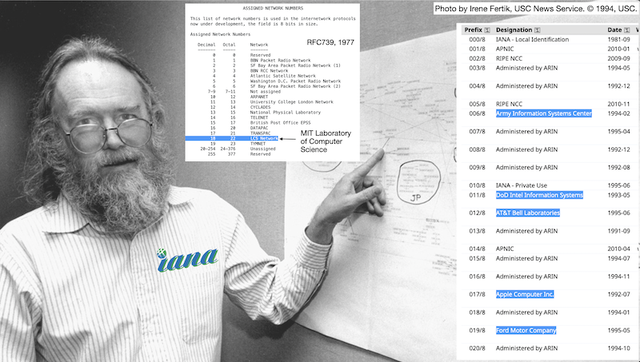
总之,我想你明白我要说的是什么了:我们被告知,IANA 将 IP 空间分配给地区注册管理机构,他们进一步管理分配的网络块。一些早期采用者从 Jon Postel(最初的 IANA)那里得到了一份特别的礼物:他们自己的 /8。
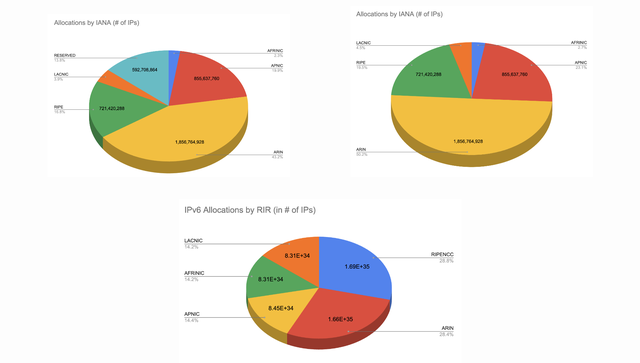
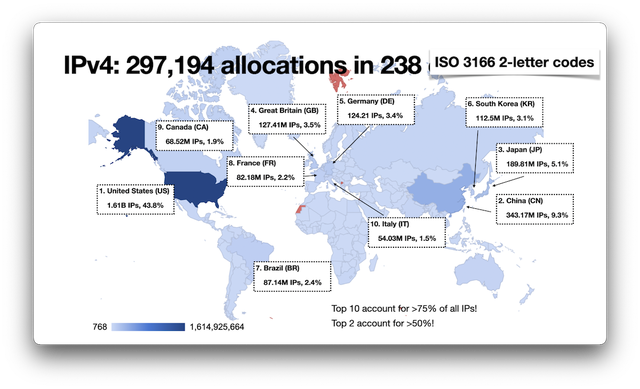
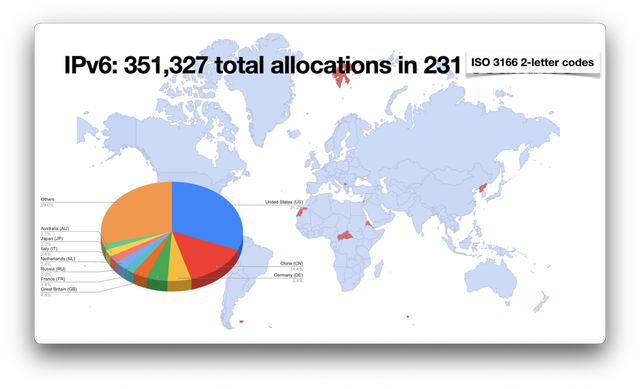
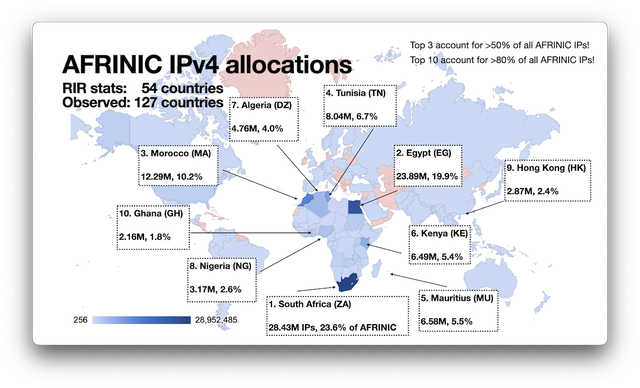
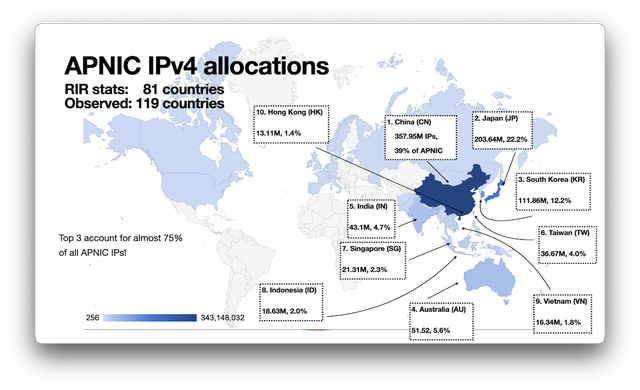
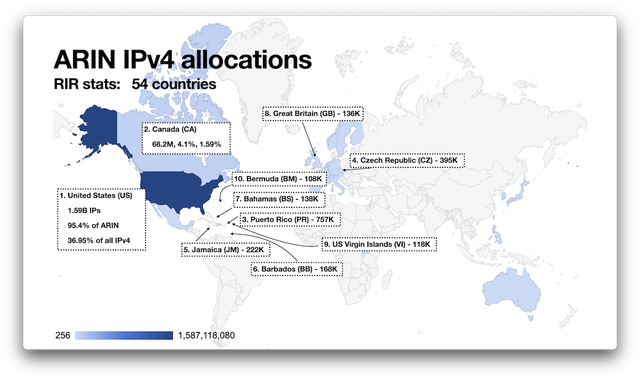
在区域注册表级别,可用的 IP 空间没有均匀分配。如果我们去掉保留的 IP 空间(总共 35 /8,包括 E 类、组播和选定的其他网络块),只查看分配给不同区域互联网注册机构 (RIR) 的实际可用 IP 地址,那么我们会发现 ARIN 管理着超过 50% 的 IPv4 IP 空间,而 AFRINIC 只管理着 2.7%。相比之下,IPv6 地址空间的分配要均匀得多:
当然,当我们用完 IP 地址时,网络块被重新分配和重新分配,在区域注册表之间转移,公司开始交易网络块,如果你有一个备用的 /9 左右,这被证明是一个非常好的快速赚钱方式。
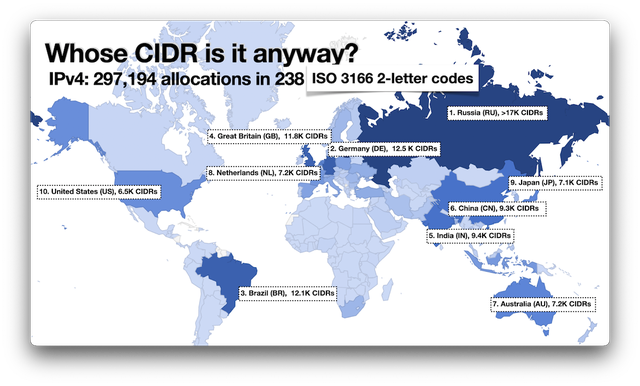
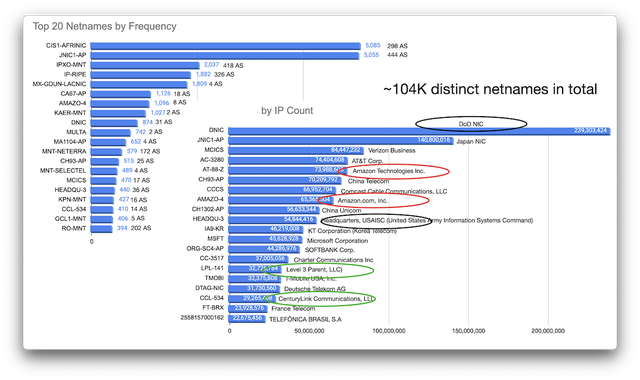
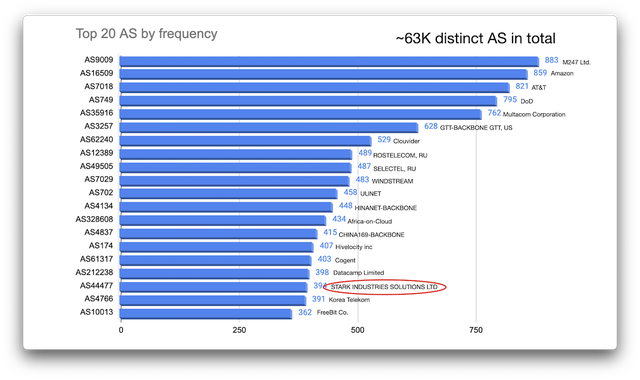
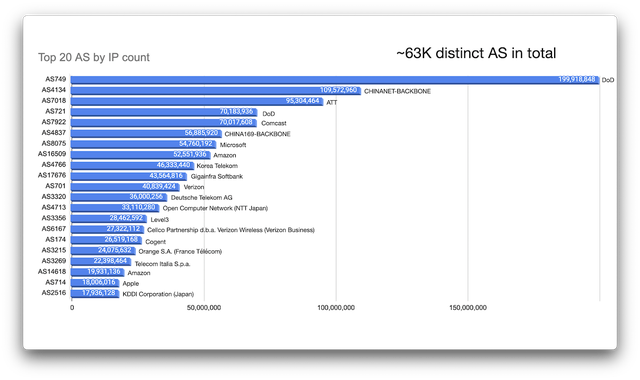
但观察到的 AS 频率是一个因素。如果我们统计给定 CIDR 的 IP 地址并按 AS 映射这些地址,则会出现不同的视图:
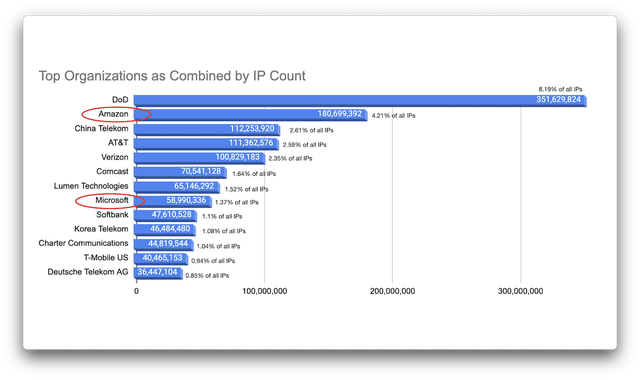
换句话说,我们发现自己是触摸大象的盲人之一——我们从不同的侧面得到不同的观点,却没有真正得到完整的视角。尝试将 AS 编号和网络名称组合在一起并手动将它们与实体相关联,我得出了拥有最多 IP 地址的顶级组织的粗略分布,这些地址占所有 IP 空间的很大一部分,并且至少在一定程度上回答了我们最初的问题。前十名(无论如何,按这个计数计算)是:
美国国防部(352M 个 IP 地址,占所有 IPv4 地址的 8.19%)
亚马逊(181M,4.21%)
中国电信 (112M, 2.61%)
AT&T (111M, 2.59%)
Verizon (101M,2.35%)
康卡斯特 (71M, 1.64%)
Lumen Technologies (65M, 1.52%)
Microsoft(59M,1.37%)
软银 (48M, 1.1%)
韩国电信 (46M, 1.08%)
这里需要指出的一点(除了 DoD 是一个明显的异类)是只有两家公司不是电信提供商:Amazon 和 Microsoft。所有其他公司实际上是 ISP 和 Telco。
The allocation of Internet Protocol version 4 (IPv4) address space to various registries is listed
here. Originally, all the IPv4 address spaces was managed directly by the IANA. Later parts of the
address space were allocated to various other registries to manage for particular purposes or
regional areas of the world. RFC 1466 [RFC1466] documents most of these allocations.
Indicates the status of address blocks as follows:
RESERVED: designated by the IETF for specific non-global-unicast purposes as noted.
LEGACY: allocated by the central Internet Registry (IR) prior to the Regional Internet Registries
(RIRs). This address space is now administered by individual RIRs as noted, including maintenance
of WHOIS Directory and reverse DNS records. Assignments from these blocks are distributed globally
on a regional basis.
ALLOCATED: delegated entirely to specific RIR as indicated.
UNALLOCATED: not yet allocated or reserved.
192.0.2.0/24  reserved for TEST-NET-1 [RFC5737].
Complete registration details for 192.0.2.0/24 are found in [IANA registry iana-ipv4-special-registry].
192.88.99.0/24 reserved for 6to4 Relay Anycast [RFC3068]
Complete registration details for 192.88.99.0/24 are found in [IANA registry iana-ipv4-special-registry].
192.88.99.2/32 reserved for 6a44 Relay Anycast [RFC6751] (possibly collocated with 6to4 Relay
at 192.88.99.1/32 - see [RFC3068] section 2.4)
192.168.0.0/16 reserved for Private-Use Networks [RFC1918].
Complete registration details for 192.168.0.0/16 are found in [IANA registry iana-ipv4-special-registry].
The IETF has reserved the address block of 192.0.0.0/24 for use for
special purposes relating to protocol assignments. This registry
contains the current assignments made by the IETF from this address
block.
Address prefixes listed in the Special Purpose Address Registry are
not guaranteed routability in any particular local or global context.
[1] Several protocols have been granted exceptions to this rule. For
examples, see [RFC4379] and [RFC5884].
[2] Not useable unless by virtue of a more specific reservation.